Most articles about Grand Marina Saigon focus on getting in: entry price, payment plans, discounts. But for an investor, the equally important question is how you get out when the time comes. This article skips entry pricing entirely and concentrates on the exit strategy: how the secondary market is operating right now, who buys resale Marriott branded units, the transfer process, and the costs you should budget for in advance.
How active is the Grand Marina secondary market right now?
Confirm developer inventory and resale availability for the exact unit at the time of enquiry.
This is a major difference from many other luxury projects. Confirm developer inventory and resale availability for the exact unit at the time of enquiry. Marriott concierge is operating and residents have moved in. When a project is genuinely "alive," resale buyers see the real unit, the real building and the real service, which makes secondary transactions far smoother than trading contracts on a project still under construction.
Because both Phase 1 and Phase 2 are fully handed over, a share of units already has owners, and a portion of those are listed for resale — creating the secondary supply that new buyers can access. How easily any single unit sells, however, depends on the unit type, floor, view and the asking price at the time of listing.
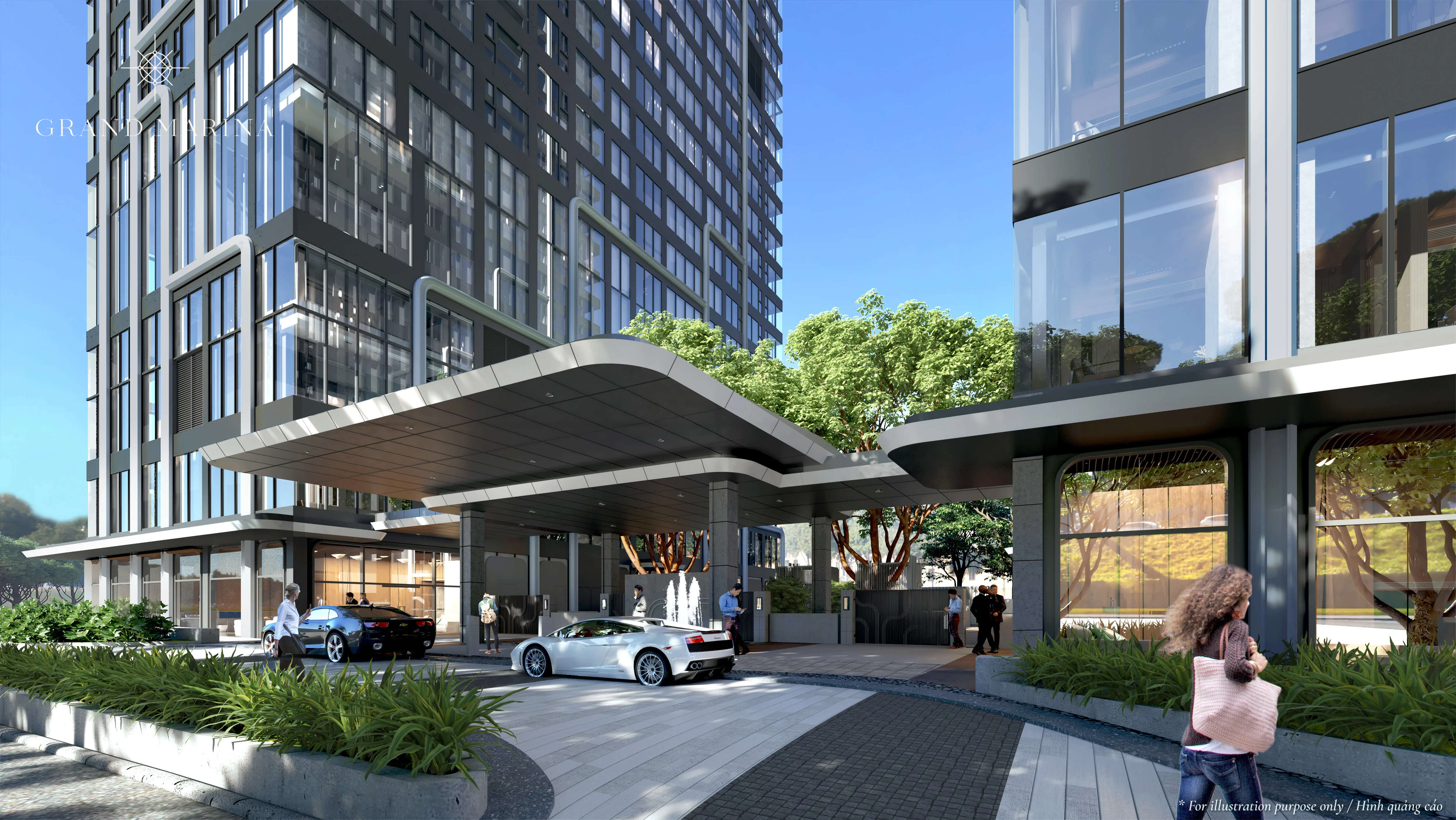
Who buys resale branded residences on the secondary market?
Resale buyers are mainly end-buyers who want a finished, move-in-ready unit they can see in person, rental investors, and foreigners seeking a unit within the remaining 30% foreign quota of the tower.
The secondary buyer pool generally breaks down into these groups:
- Owner-occupiers who want to move in now: no waiting for construction, and a finished unit built to Marriott standard with Poggenpohl/Boffi kitchens, Miele/Gaggenau appliances and Daikin VRV air conditioning.
- Rental investors: focused on cash flow and Marriott-run operations; review the rental yield analysis before committing (note: this links to a related article in the News section).
- Foreign buyers: looking for a unit still within each tower's 30% foreign-ownership cap — a critical group, because once a tower's foreign quota is full, foreigners can only buy from another foreigner who is selling.
Precisely because of the 30%-per-building cap, a unit already held in a foreigner's name can be a scarce asset for the next foreign buyer, especially in towers that are close to their quota. If you are a foreign investor, read the Foreign Investor Guide to Grand Marina Returns carefully to understand both the opportunity and the risk on the way in and the way out.
Why does the Marriott brand affect resale liquidity?
The Marriott & JW Marriott brand creates differentiation that makes a unit easier to position and easier to tell a sales story around — but it is not a promise about price.
According to market research firms such as Knight Frank and Savills (figures published in recent years), branded residences globally are typically priced 25–35% above comparable non-branded apartments. This is a market reference, not a guarantee that your specific unit will appreciate. The premium reflects the brand, the operating service and the handover standard — the very factors that help a unit stand out when relisted.
To understand why that premium exists and where it comes from, see Why Branded Residences Cost 25-35% More. And if the concept is new to you, What are branded residences? explains the basics. The key point to remember: real liquidity and resale price depend on the project, the timing and policy — outcomes are not guaranteed.
What steps are involved in transferring a Grand Marina unit?
A transfer involves checking the unit's legal status, signing the transfer contract, notarizing/certifying as required, paying taxes and fees, then completing the title change or updating the sale contract.
Depending on whether the unit already has its pink book or is still under a sale contract with the developer, the steps vary, but the general framework is:
- Verify legal status: the pink book (long-term for Vietnamese; 50-year, renewable ownership for foreigners), any mortgage, and remaining financial obligations.
- Agree on price and place a deposit between seller and buyer.
- Sign the transfer contract and notarize/certify it in line with Vietnamese law.
- Complete tax and fee obligations and process the title change or register the new buyer with the developer.
For foreigners, the project provides bilingual paperwork and translation support, and the transaction must still stay within that tower's 30% foreign-ownership cap. The advice here is general — you should carefully review the legal file of the specific unit and seek professional guidance before signing any document.
What does reselling cost, and how is the 0.5% registration fee calculated?
The single largest title-change cost is the registration fee of 0.5% of value, plus income tax on the transfer and service fees — all of which should be netted out of your return from the start.
The table below is a reference for the costs commonly seen on a transfer (illustrative; actual amounts depend on the transaction and current regulations):
| Cost item | Reference level | Note |
|---|---|---|
| Registration fee (title change) | 0.5% of value | Main cost to update ownership |
| Income tax on property transfer | Per regulation | Based on transfer price; seller should budget for it |
| Notary & paperwork fees | Per fee schedule | Varies with transaction value |
| Management / operating fee | ~USD 8–9 /m²/month | New owner continues to pay; affects the buy decision |
Note that the ~USD 8–9/m²/month management fee (subsidized by the developer for the first 3 years) is a recurring cost the owner carries — and it also shapes the resale buyer's decision. To see the full holding picture, read Grand Marina's True Annual Holding Cost. All figures above are indicative only; specific tax and fee rates may change per regulation.

How do you position a unit to resell more easily?
Easy-to-sell units tend to have a good view (river/Thu Thiem), a good floor, a popular unit type, clean legal status, and a title that still leaves "room" for a foreign buyer.
Several factors tend to help a unit stand out on the secondary market:
- View and orientation: Saigon River and Thu Thiem New Urban Area views are generally more sought-after.
- Unit type: popular types such as 1BR (~50–60 m²) and 2BR (~70–90 m²) have a wide buyer pool; Dual-Key, Sky Villa and Penthouse units are more niche but also rarer.
- Clean legal status: a clear pink book/contract, free of complicated mortgages, makes the deal move faster.
- Fixed location advantages: about 250 m from Ba Son Metro station and 200 m from the Saigon River — pluses that do not change over time.
There is no formula that guarantees a fast or profitable sale; liquidity depends on supply and demand, timing and the prevailing price level. Before setting a resale price, compare against the current Pricing & payment and real transaction levels to set realistic expectations.
When should you consider exiting?
The timing of an exit should be based on your personal goals and the market conditions at that moment — never on any promise of appreciation.
Some investors choose to hold for rental cash flow (the project page cites an indicative yield of 3.5–5% per year), some prefer to take profit when the market is favorable, and others need liquidity for a different financial goal. There is no single "golden moment" for everyone — the decision depends on your own cash flow, plans and risk appetite.
The key point: actual resale outcomes depend on the project, the timing and policy — there is no guaranteed return. Keep expectations realistic, review the specific legal documents and price list before deciding, and talk to someone who knows the local secondary market.
Note
Prices, areas and timelines may change per the developer's official announcements. Please contact us on Zalo 0903 475 802 for the latest documents and price list.