After years of construction, Ho Chi Minh City's Metro Line 1 (Ben Thanh–Suoi Tien) has entered commercial service. For home buyers this is more than a commuting upgrade — proximity to a rail station is an infrastructure factor that global property researchers track closely, because distance to a station often correlates with residential value. This piece looks at the topic through the lens of transit-oriented development (TOD), rather than as a location guide.
How does metro infrastructure relate to property values?
Globally, homes closer to a metro station tend to hold value and trade more readily than those far from public transit, though the size of the effect varies widely by city.
"Transit-oriented development" (TOD) refers to clustering housing, offices and services around rail stations. When a new metro line opens, journey times become shorter and more predictable, which tends to lift the appeal of properties within walking distance of a station.
- Shorter, more reliable journeys to major employment hubs
- Less reliance on private vehicles — an advantage in a dense city like HCMC
- More retail and dining clustering around the station area
- Greater liquidity — a broader pool of buyers and tenants
These factors typically feed gradually into rents and prices, but the magnitude depends heavily on the specific project, timing and policy. This is a market reference, not a promise of returns.
How much does distance to the station matter?
Most of the "near-metro" advantage is concentrated within a short walking radius of a station — often discussed in the range of a few hundred metres.
Studies by international advisers such as Knight Frank and Savills over many years consistently show the "station-proximity" effect fading quickly with distance: an apartment a few minutes' walk from a station tends to benefit far more clearly than one in the same district but 1–2 km away. That is why buyers pay close attention to the exact "how many metres to the station" figure.
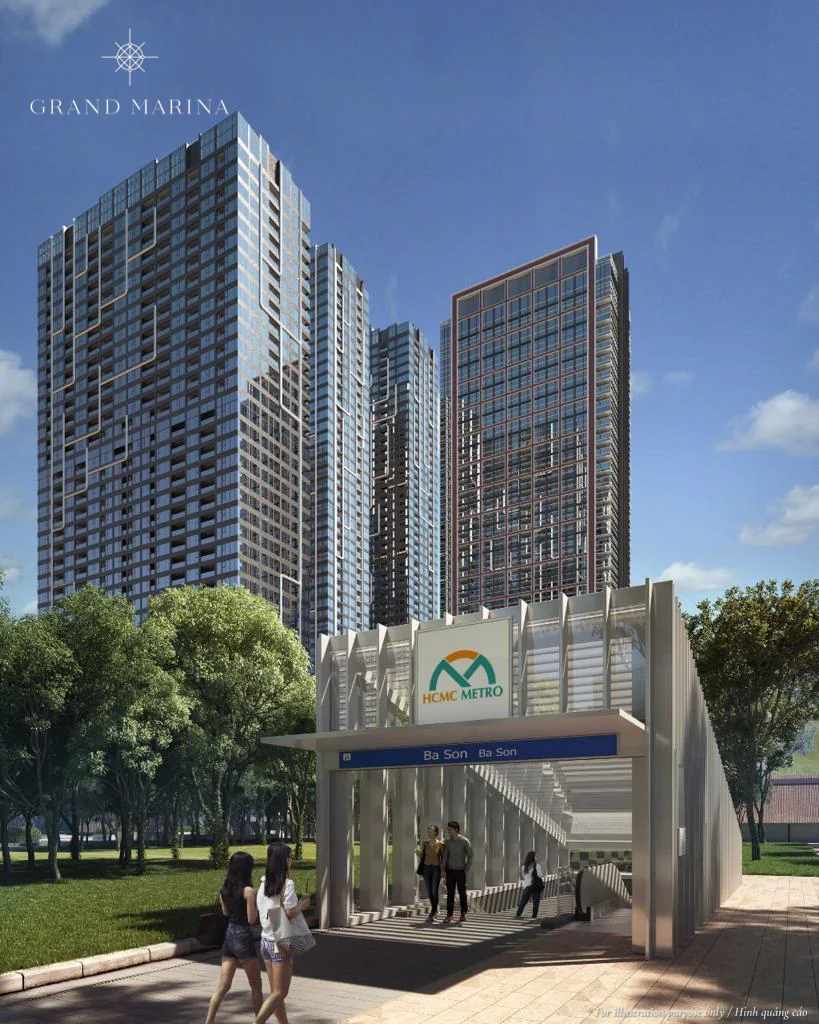
In the HCMC context, according to project information, Grand Marina Saigon is about 250 m from the Ba Son station on Metro Line 1 and roughly 200 m from the Saigon River. That is a few minutes on foot — squarely within the band that international studies associate with the clearest connectivity advantage. You can read more in the About the project page.
What is special about Metro Line 1 and Ba Son station?
Ba Son station sits in the District 1 core, links quickly to Ben Thanh and the Opera House, and runs east along the corridor through Thao Dien and An Phu out to Suoi Tien.
According to project information, from Ba Son station it is about 1 minute to Ben Thanh, around 30 seconds to the Opera House, roughly 5–8 minutes to the An Phu/Thao Dien area, and about 25 minutes to Suoi Tien. This corridor ties the District 1 financial core to the upscale residential neighbourhoods to the east and to the universities and tech park at the end of the line.
| Destination from Ba Son station | Metro time (per project information) |
|---|---|
| Ben Thanh | ~1 min |
| Opera House | ~30 sec |
| An Phu / Thao Dien | ~5–8 min |
| Suoi Tien (end of line) | ~25 min |
These travel times are indicative per project information and may change with the actual operating schedule. The notable point is that Ba Son is on the central segment — where the density of work, shopping and cultural destinations is highest along the whole line.
If you want to compare metro distance against specific unit lines, our team can send a detailed location map.
Why do buyers care so much about "near-metro" apartments?
Because fast connectivity makes an apartment easier to rent, easier to resell, and a fit for international tenants — all factors that support long-term liquidity.
In Asian cities with mature metro networks, "walk-to-station" apartments are typically among those that residents and tenants prioritise. For a luxury project like Grand Marina — Vietnam's first Marriott & JW Marriott Branded Residences — the metro factor adds to existing advantages:
- Central District 1 setting, on the Saigon River, facing the new Thu Thiem urban area
- Marriott-standard operations: 24/7 concierge, multi-layer security, hotel-grade amenities
- A tenant pool of expatriates and executives who usually favour well-connected districts
It is worth stressing that metro connectivity is a supporting factor, not the sole driver of value. Legal status, handover quality, the operating brand and market timing all matter. You can read more about the value of the branded model in What are branded residences?.
Where does Metro Line 1 fit in the bigger market picture?
The metro opening is one of several infrastructure and macro factors shaping HCMC's high-end property market — it does not stand alone.
The eastern Saigon corridor — Ba Son, Thu Thiem and the metro alignment — is one of the most closely watched areas. According to research firms such as Knight Frank and Savills, branded residences are typically priced 25–35% above comparable non-branded luxury units, reflecting operating value and liquidity — this is a market reference, not a commitment for any specific project.
To see how the metro blends with other factors such as supply, interest rates and foreign capital flows, see HCMC Luxury Property Market 2026: Data & Trends and Vietnam Real Estate 2026 Outlook: Macro Factors to Watch. For international buyers, the exchange rate is also worth weighing — see USD/VND & Foreign Investors Buying Property in Vietnam.
What should buyers keep in mind about the metro factor?
Treat the metro as a supporting advantage to verify alongside legal status, the price list and official documents — do not decide on the expectation of price growth alone.
A few practical points to consider:
- Confirm the actual distance from the apartment to the station and the walking route
- Compare current local rents and sale prices for a realistic reference base
- Check the legal status, title and ownership terms (foreigners: 50 years, renewable per law, capped at 30% of units per building)
- Read carefully the payment terms, management fee (~USD 8–9/m²/month, subsidised for the first 3 years) and other charges
All figures for price, area and timeline are indicative and may change per the developer's official announcements. Actual results depend on the project, timing and policy — there is no guarantee of price appreciation.
Want an objective read on location and legals before deciding? Let's talk directly.
Note
Prices, areas and timelines may change per the developer's official announcements. Please contact us on Zalo 0903 475 802 for the latest documents and price list.