As 2026 begins, Vietnam's real estate market faces several important macro shifts: a new legal framework is now fully in force, borrowing costs remain relatively low, and foreign capital keeps flowing in. This article does not offer a firm forecast — instead it lays out scenarios built on publicly available data and views from international advisory firms, so you can judge for yourself. Any actual outcome depends on the specific project, timing and policy.
What does the 2026 macro picture look like?
The four pillars of 2026 are the new legal framework, interest rates, GDP growth and FDI flows — all leaning supportive of the market, but none of them guarantees prices will rise.
After the 2022–2023 slowdown, Vietnam's property market entered a gradual recovery from 2024 that is expected to continue into 2026. According to market reports from Knight Frank and Savills published in 2024–2025, buyer confidence and liquidity in HCMC's high-end segment have improved clearly from the cycle low, though the recovery has been uneven across segments.
The key thing to remember: this is reference context, not a commitment. A favourable macro backdrop reduces risk, but each specific unit still needs its own due diligence on legal status, location and price at the moment of purchase.
How does the 2024 land law affect buyers?
The amended framework (Land Law, Housing Law, Real Estate Business Law) aims for more transparency in valuation, transactions and foreigner rights, but buyers still need to read each unit's paperwork carefully.
The three amended laws, effective from mid-2024, are widely seen as the biggest legal turning point in years. A few points often raised in market analysis:
- The old land-price bracket is gone, replaced by a land-price table closer to market levels — more transparency, but potentially higher input costs too.
- Clearer rules on launch conditions and bank guarantees for off-plan housing, giving buyers stronger protection.
- The mechanism allowing foreigners to own homes continues, subject to specific conditions and caps.
For foreigners eyeing a project like Grand Marina Saigon, two baseline figures still apply under Vietnamese law: a 50-year ownership term (renewable per the law) and a cap of up to 30% of units per building reserved for foreign buyers. You can also read more on what are branded residences? to see how the branded segment works within this framework.
How do 2026 interest rates affect the buying decision?
Home-loan rates in Vietnam in 2026 are relatively low compared with 2022–2023, improving affordability — but buyers should still model the floating rate that applies after the promotional period.
Following monetary-policy adjustments, deposit and lending rates have cooled markedly since late 2023. For Grand Marina specifically, partner banks such as Techcombank, VPBank, MB and BIDV lend up to roughly 70% of the unit value, with terms up to 25 years. Many sales programmes also offer a 0% interest/grace period until handover, or an 8–12% discount for fast payment of 95–100%.
Bear in mind the headline promotional rate differs from the later floating rate. When planning your finances, test several scenarios so your cash flow stays safe even if rates climb. If you are an international investor, currency movement is another variable — a topic covered in USD/VND & Foreign Investors Buying Property in Vietnam.
Will GDP and FDI keep supporting the market in 2026?
Sustained high GDP growth and steady FDI flows are two fundamental drivers of housing demand, especially in the high-end segment of major cities.
Vietnam remains one of the region's faster-growing economies, with an expanding middle and upper class and a larger pool of foreign professionals. According to Knight Frank and Savills views in their 2024–2025 reports, this resident base creates real demand for high-end apartments and branded residences in the centre — both to live in and to lease.
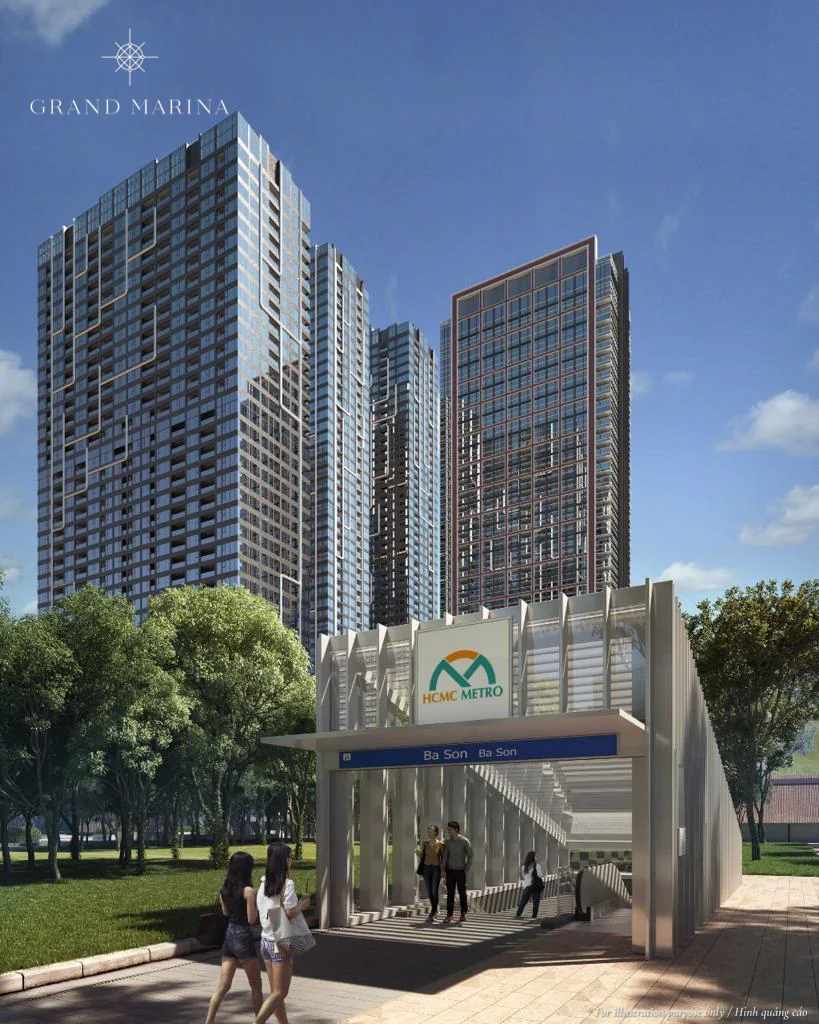
High-quality FDI also brings housing demand from professionals. In District 1 specifically, infrastructure such as Metro Line 1 (Ba Son station is about 250 m from Grand Marina and now commercially operating) and the Thu Thiem New Urban Area across the river help underpin the long-term value of a central location. You can learn more on the About the project page.

Where does the branded residence segment sit in the 2026 picture?
Branded residences are typically priced above comparable non-branded high-end apartments and tend to hold liquidity better in a recovery, though the premium varies by project and timing.
According to reference data from Knight Frank and Savills (2024–2025), branded residences worldwide are usually priced 25–35% above comparable non-branded high-end apartments. This is a market reference, not a commitment for any single project.
| 2026 macro factor | Reference trend | What it means for buyers |
|---|---|---|
| New legal framework (2024) | More transparency, better buyer protection | Still read each unit's paperwork |
| Home-loan rates | Relatively low vs 2022–2023 | Model the post-promo floating rate |
| GDP growth | High by regional standards | Real demand in the high-end segment |
| FDI flows | Steady, higher quality | Rental demand from professionals |
| Branded residences | ~25–35% premium (KF/Savills, 2024–2025) | A reference, not a promise |
The table above only collects reference trends to give you an overview; every valuation figure and premium changes with each sales phase and market movement. To understand how this segment performs in practice, see Foreign Demand for Vietnam's Luxury Property and Branded Residences: Resale & Rental Performance Data.
What should buyers prepare for the 2026 scenarios?
Focus on what you can control: clear legal status, a central location, financial capacity tested across scenarios, and reliable information sources.
A few practical steps to help you decide calmly in 2026:
- Request the full legal file and an up-to-date price list for the specific unit.
- Model your cash flow across several rate scenarios, not just the opening promotional rate.
- Compare the true cost of ownership: 10% VAT, 2% maintenance fee, management fee (~USD 8–9/m²/month, subsidised for the first 3 years at Grand Marina), 0.5% registration.
- Cross-check market views from trusted sources such as Knight Frank and Savills, with a time reference.
These figures are indicative and change with each sales phase; they help you estimate the total cost rather than looking only at the headline price. Indicative rental yields at Grand Marina run around 3.5–5% per year depending on unit type and timing — again a reference, not a guarantee.
Conclusion: read the macro, decide unit by unit
The 2026 macro picture leans supportive, but a sound buying decision still rests on the legal status, price and cash flow of each specific unit.
Factors such as the new legal framework, lower interest rates, rising GDP and steady FDI create a positive foundation for Vietnam's property market in 2026. Even so, that is the general backdrop — not a guarantee for any single apartment. Use the scenarios above as a reference tool, then do thorough due diligence on each opportunity before you commit.
Note
Prices, areas and timelines may change per the developer's official announcements. Please contact us on Zalo 0903 475 802 for the latest documents and price list.